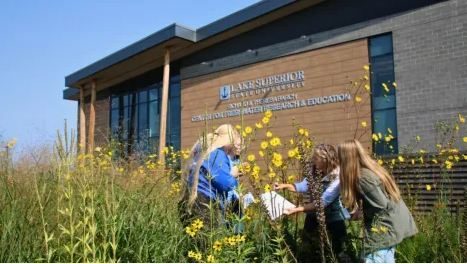
When Dick and Theresa Barch think about Lake Superior State University, they don’t just see a university — they see a place where students get their hands in the water, where curiosity turns into discovery, and where future stewards of the Great Lakes are shaped through real experience in the field.
That belief is now reflected in one of the most significant philanthropic investments in LSSU history.
A transformational $3 million gift from the Barch family is expanding the University’s Center for Freshwater Research and Education (CFRE) in powerful new ways. Their support establishes the Richard and Theresa Barch Endowed Executive Directorship—the first named directorship at LSSU — and provides resources that will directly shape the next generation of Great Lakes scientists.
At the heart of their gift is a deep commitment to students. An Excellence Fund will support undergraduate and graduate research, expand access to advanced scientific equipment, and help provide a new, larger research vessel. These enhancements will allow more students to leave the classroom and step directly into the waters, wetlands, and shorelines that define the region.
For Dr. Ashley Moerke, Executive Director of CFRE and the inaugural holder of the Richard and Theresa Barch Endowed Executive Directorship, the impact is both immediate and far-reaching.
“This extraordinary investment strengthens our ability to grow research and student training at a scale that impacts not only LSSU, but the entire Great Lakes region,” Moerke said. “It ensures we can continue generating science that informs conservation, policy, and resource management across freshwater ecosystems.”
Dr. Kevin Kapuscinski, Professor and holder of the Vanderploeg Endowed Assistant Directorship at CFRE, emphasized how the gift expands both opportunity and capacity. “This level of support allows us to expand the scope of our research and involve more students directly in applied fieldwork,” Kapuscinski said. “With upgraded equipment and a larger vessel, we can better protect the Great Lakes while preparing students for careers in conservation and natural resource management.”
CFRE has long served as a hands-on hub for applied research and workforce development, where students work alongside faculty and partners from tribal, federal, and state agencies, as well as industry. They don’t just observe research—they participate in it, from collecting field samples to contributing to long-term studies that inform real-world environmental decisions.
That experience is exactly what the Barch family values most.
“CFRE gives students an experience most other universities simply cannot offer,” said Richard Barch. “Working in rivers, wetlands, and lakes—getting into the environment itself—creates a level of understanding and appreciation that can’t be replicated in a classroom. Turning over rocks in a stream or along a lake bottom brings a kind of connection that stays with you.”
For students, that connection is life-shaping.
Senior Fisheries and Wildlife Management student Aiden Cardwell describes CFRE as a place where learning becomes personal. “It bridges theory and real-world impact,” Cardwell said. “From water quality analysis to fisheries work and public engagement, CFRE has shaped my sense of place and my appreciation for freshwater science in ways I never expected.”
The timing of the Barch gift also aligns with LSSU’s new accelerated 4+1 Master’s Program in Fisheries and Wildlife Management, which allows students to earn both undergraduate and graduate degrees in five years while gaining extensive field and research experience. CFRE plays a central role in supporting that pathway and expanding opportunities for emerging professionals.
One example of its leadership is a groundbreaking oil spill research initiative using controlled mesocosms to simulate freshwater ecosystems. Conducted in partnership with Algoma University, the University of Windsor, and the U.S. Coast Guard, the project gives students hands-on research experience while contributing to critical understanding of spill response and recovery in freshwater systems.
For Lake Superior State University — Michigan’s smallest public university — the Barch family’s generosity is especially meaningful. It expands opportunity where it matters most: in the field, in the lab, and in the lived experience of students preparing to protect the Great Lakes.
Their gift is more than an investment in infrastructure or equipment. It is an investment in people, in place, and in a shared belief that meaningful learning happens when students are given the chance to do the work themselves.
In every sense, it is a legacy gift — one that will be felt not only in the growth of CFRE, but in the students whose lives are changed by the experiences it makes possible.