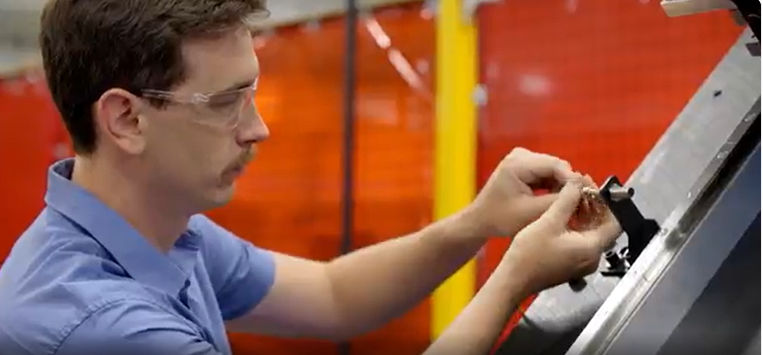
Since graduating from Lake Superior State University in 2018 with a degree in Mechanical Engineering and a focus in Robotics and Automation, Cord Sutter has built a thriving career in custom automation. From his start as a Project Engineer with Esys Automation — acquired by JR Automation the day he began — to his current role as Senior Controls Project Engineer, Cord has designed and programmed machines for industries ranging from aerospace to food and beverage. Known for his technical expertise, adaptability, and passion for mentorship, Cord continues to tackle new challenges while helping shape the next generation of engineers. Please enjoy reading this Q&A interview with Cord to learn more about his journey and insights.
To start off, tell us a little bit about yourself. How did your career path lead you to your current role as a Senior Controls Project Engineer at JR Automation?
After graduating from Lake State with a bachelor’s degree in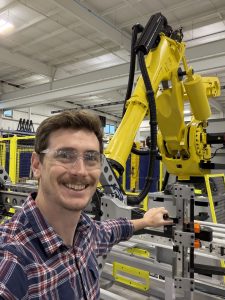 mechanical engineering and a concentration in robotics and automation, I knew I wanted to work for an integrator of custom automation, thanks to my internship experiences. While navigating job offers during the fall of 2018, Esys Automation and JR Automation rose to the top. Ultimately, I accepted a controls programming role with Esys under the title of “Project Engineer.” The day that I started (along with a few other fellow LSSU graduates) is the same day that Esys Automation was officially acquired by JR Automation. I was thrilled! I spent 2 years programming robots, vision systems, and PLC code from scratch as we commissioned new machines for automotive, defense, food and beverage, aerospace, and logistics industries.
In 2020, my wife and I got married and were looking for a change of pace. I was able to transfer to one of JR Automation’s business units in South Carolina, taking on a new title of “Controls Engineer II.” While there, I commissioned machines for many industries and customers, including medical, logistics, consumer goods, food and beverage, and textiles. I was fortunate to gain both experience as well as responsibility, taking on titles such as Controls Engineer, Senior Controls Engineer, Senior Controls Project Engineer, and Controls Project Engineering Manager. I rediscovered my love for teaching and mentoring as I managed a team of controls engineers, several of whom were leading projects of their own for the first or second time. Communication and relationship-building with customers, superiors, peers, and cross-functional team members is key to success in almost any career, and engineering is no exception. It’s the reason that I enjoy and embrace both the interpersonal as well as the technical aspects of my job.
In June of 2025, my wife and I made the decision to move back to our home state. Once again, I was able to transfer to another location with JR Automation, landing near our families in West Michigan. Since a new location also means learning new faces, new customers, and new standards, I felt much more comfortable stepping back into a lead engineering role (Senior Controls Project Engineer) as opposed to management.
The theme throughout my career so far has been flexibility and adaptation. With each new project comes an expectation that you quickly become an expert on a new-to-you process for an industry with which you might have little to no familiarity. Sometimes we can work remotely. Oftentimes we work from a central office. And, yes, sometimes we travel. No two days are ever the same. I always say, “If you don’t like what you’re doing, wait 6 months.” You’ll likely be working on a different machine that’s doing a different process for a different customer in a different industry in a different city.
Thinking back to your college days — what first drew you to Lake Superior State University?
There were at least 3 major things that drew me to LSSU over other universities. First, as an avid outdoorsman, I was intrigued by Lake State’s proximity to the natural world; there was a sense of adventure about being “up north” while still only 4 hours from family. Second, the robotics lab coupled with small class sizes gave me confidence that I could build relationships with my professors without being “lost in the crowd” as I pursued a career in automation. Lastly, (and not insignificantly!) Lake Superior State University’s low cost and high availability of scholarships made it the most affordable option, ensuring value.
 What sparked your interest in engineering, and specifically in the world of controls and automation?
As a mechanical engineering student with farm-town beginnings, I entered college with zero exposure to program languages. Throughout my studies, I found myself gravitating towards the dual nature of programming: logic and creativity. I learned that for me, personally, mechanical design was better suited as a hobby. Exposure to robotics, programmable logic controllers, machine vision, and relevant internships taught me that there was a very accessible career path that combines the theoretical nature of programming with tangible processes and real-world physics. For me, controls engineering is the perfect balance of logic and theory with hardware and physical application.
In what ways did your experience at Lake Superior State University help shape your path into engineering and project leadership?
• As a math and engineering tutor, I developed a passion for the teaching and mentorship that I’ve had the opportunity to reignite in recent years.
• As leader of the Engineering House on campus, I learned lessons in communication and accountability.
• As a member of the SAE Mini Baja club, I learned how to geek out and really make engineering fun.
• My senior design team’s project taught me project management and time management skills.
• Engineering classes taught me many technical facts and skills.
Were there any courses, professors, or hands-on experiences at LSSU that really made a lasting impact on you?
• Dr. Jones radiated enthusiasm and positivity. This resonates with me more and more each year. His class on robot theory stands out as one that was equally challenging and rewarding.
• Dr. Moening’s PLC class was hands-down the most relevant and helpful as I started my career.
• Dr. Weber’s machine vision class was especially intriguing and relevant to my work.
Did you get involved in any extracurricular activities, engineering clubs, or design projects while at LSSU that helped you build the skills you use today?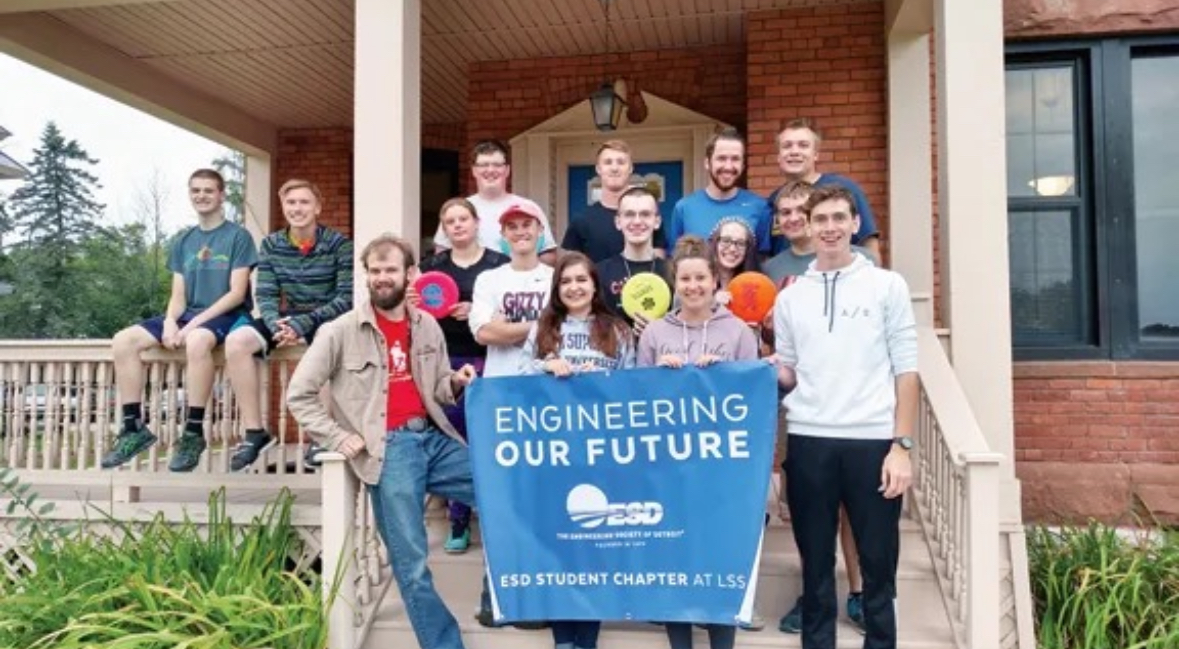
As my home for all 4 years, the Engineering House was my highest and best resource outside of the classroom. Living with peers provided study partners, homework buddies, and mentors. Being on campus gave me unfettered access to labs, professors, and convenient employment.
I enjoyed working as a tutor for individual students as well as in the drop-in math center which helped hone my skills in those disciplines and develop my ability to teach and meet people where they were at.
Intramural volleyball, ultimate, and broomball were fun and competitive but also a good way to connect with students and make friends outside of engineering.
SAE Mini Baja was a blast and taught me to get my hands dirty from time to time.
Looking back, what parts of your LSSU education have proven to be the most valuable in your career as a Senior Controls Project Engineer?
While engineering classes taught me many technical facts and skills, the most important of these skills was to develop a comfortability with approaching difficult problems with a can-do attitude. The essence of engineering is to solve new problems. It’s rare that there is a canned answer or written procedure outlining how to solve those problems. As such, your ability and willingness to navigate the unknown is just as important as solutions themselves.
Transitioning from student life to the professional world can be a big step. How did you handle that transition, and what were some of the challenges you faced early on?
The transition from student life to the professional world was easier than I expected in that I never had unfinished homework or the pressure of an upcoming exam bearing down on me. When you leave the classroom, your work for the day might only be half done. I found that, for me, the boundaries between personal and professional responsibility took on more clarity after college. That said, who knew meal planning, grocery shopping, and cooking were such a chore?!
Were there particular internships, co-op experiences, or senior design projects that gave you a good sense of what real-world automation work would be like?
The closest thing to a real-world project that I did in school was team STS’s Senior Design Project. We overhauled the engineering department’s thermal trainer unit, a project that involved mechanical and electrical design and fabrication, fluid dynamics and heat transfer calculations, programmable logic controller and human/machine interface programming, and the development of 5 unique lab procedures. It required us to work cross-functionally, coordinating budgets and schedules to meet hard deadlines. All throughout, communicated with stakeholders regarding overall progress, technical challenges, and their solutions.
I also took on a few different summer internships, the most impactful of which was for Textron Aviation in Wichita, Kansas. I participated as a member of a small team of automation engineers and had the opportunity to do mechanical and electrical design and to work with vision systems, robots, PLCs, and HMI’s. I even got to fly airplanes in my spare time! Not that it related to my career in any way, but it was impactful nonetheless.
Can you walk us through what a typical day looks like for you at JR Automation? What kinds of projects or responsibilities fill your time?
A typical day takes on many different forms, largely impacted my which phase of a project I’m working on at any given time. For example:
During the first stage of a project, I’m:
• Working either at home or in an office.
• Meeting with customers to understand and define project scope.
• Meeting with colleagues to ensure design compatibility between the different disciplines.
• Researching and selecting technologies and components we will use in the design.
• Project planning (engineering resource availability, task planning, etc.).
Next, I slowly transition to:
• Meeting with vendors to ensure they’re meeting design criteria.
• Assisting our electrical design team to make high level design decisions.
• Onboarding other controls engineers onto the project.
• Offline programming (preemptive programming, before the machine is built or wired).
• Delegating programming tasks.
Once the machine is built and powered on, I start:
• Working on the shop/build floor.
• Debugging code.
• Identifying mechanical and electrical issues and collaborating on their correction.
• Delegating tasks to other controls engineers.
• Communicating with management regarding progress and any roadblocks.
Once the machine is working, I:
• Host the customer at our facility.
• Demonstrate the machine’s functionality.
• Make any appropriate changes or corrections.
Once we ship a machine to the customer’s site, I’m:
• Working at the customer’s facility.
• Integrating the machine into the new environment (working with I.T., other vendors, existing equipment, new materials, etc.)
• Confirming full machine functionality.
• Communicating with team members who are not onsite to facilitate their involvement at all levels.
Rinse and repeat. Sometimes I lead multiple projects at a time or there might be overlap in project schedules, which adds variability.
Automation technology evolves quickly. How do you stay current with new control systems, software, or emerging innovations in the industry? Are there any trends that particularly excite you?
Our vendors do a fantastic job of keeping us up to date with the trends in technology. Since we build equipment for manufacturers, we tend to use mature technology that is robust and supportable. This means that most of our machines are built using technology that has made its way into the broader market and may have already existed for a couple years. On occasion, however, a process might necessitate the use of an emerging technology. In these scenarios, we partner hand-in-hand with our customer to develop a solution.
What do you enjoy most about working at JR Automation? What makes it a great environment for engineers to learn, grow, and collaborate?
Above all else, I enjoy the variety of work at JR Automation. If life is about balance, then I’d say this is the sweet spot. There are busy seasons and there are times when you can catch your breath. I’ve had opportunities to work from home, office, shop floor, and at customers’ facilities across North America. I’ve worked on Reese’s Peanut Butter Cups, and I’ve worked on military jets. Those things coupled with the fact that technology is constantly evolving means that this job cannot get stale. JR Automation is a great place to learn, grow, and collaborate simply because we interact with so many engineering disciplines. There is virtually no field that automation can’t touch. I love seeing technology or design principles migrate from one industry to another using automation suppliers like JR Automation as a vector for that cross-pollination.
Every engineer has a few projects that stand out. Can you share a memorable project or challenge you’ve faced at JR Automation — and how you and your team worked through it?
In the world of beverage can production, not much has changed in recent decades. Picture continuous production lines churning out 2,000 pop cans per minute. It’s all a blur – a feat of mechanical engineering and magic. Discrete automation, on the other hand, typically has a cycle – a sequence of events that happens repeatedly, churning out one part (or group of parts) per cycle. We were tasked with creating a discrete machine that could intercept cans moving at high speed, do *something* to the can, and then inspect it before inserting back into the continuous line. It was a thing of beauty. Only, we were plagued by seemingly simple things once we installed the machine on the customer’s floor. Our sensors weren’t able to see certain paint colors or finishes on the cans. Air currents in the plant were knocking cans over while they were conveying. We had built one of the fastest and coolest discrete machines I’d ever seen, but it wasn’t glamorous, fancy engineering that got us across the finish line. It was late nights testing new sensors. It was fiddling with settings and installing sheet metal baffles to deflect air currents. We achieved success by grinding it out on the plant floor with the customer’s awesome maintenance crew. Sometimes I think we need reminders like that to stay humble.
What advice would you give to current LSSU engineering students or recent graduates who hope to work in automation or project engineering?
To those students who hope to work in automation or project engineering, I’d recommend that they diligently seek internship opportunities in those fields. If they are unable to secure an internship, ask to job shadow. If they’re unable to job shadow, try connecting with former graduates who work in those fields today. Heck, do all three of those things. Every connection you make in an investment in your future.
Here’s one last thing that I wish someone had outlined for me while I was still in school regarding the custom automation industry:
Controls/robotics engineers generally make good money but also have a higher travel requirement than other disciplines. Think anywhere between 10%-50% travel averaged out across a year. For a smaller project, you might be away from home for three days total for a machine install. For a larger or more complex machine install, however, you could be travelling on and off for three months or more.
Looking back on your time at Lake Superior State University, are there any moments or experiences that still stick with you or continue to influence your work today?
During my junior year, the spring semester workload was intense. One day, I got a call from my high school best friend. Tragedy had struck and he needed me. I dropped everything, drove to Grand Rapids, and spent nearly a week there with him before returning to LSSU. Unbeknownst to me, I had also met my future wife that week!
Since I had barely been keeping up with deadlines as it was and there was really no chance of recovering, I picked something to neglect and caught up on everything else. The thing that I neglected happened to be the final project for my PLC class with Dr. Moening. It was a big, time intensive project, and I had already seen several classmates fail it. Caught up on everything else, I finally turned my attention to the project, knowing full well I wouldn’t complete it by the deadline. I approached Dr. Moening, tail between my legs, and asked for an extension. Not only did he give me the extension, but he offered extra support. LSSU housing and the engineering department allowed me to stay on campus for an extra week in order to finish the project.
I have no doubt that the personal attention and grace I was given are not commonplace at larger universities. Not only did I learn a deeper appreciation for the wonderful people in the LSSU engineering department, but it solidified something that I already knew: there are some things that are more important in life than schoolwork or your career. Thank you, Dr. Moening!